Custom Dice: From Workshop Benches to Casino Tables Across Borders
Sage Butler · Oct 19, 2026

Custom Dice: From Workshop Benches to Casino Tables Across Borders
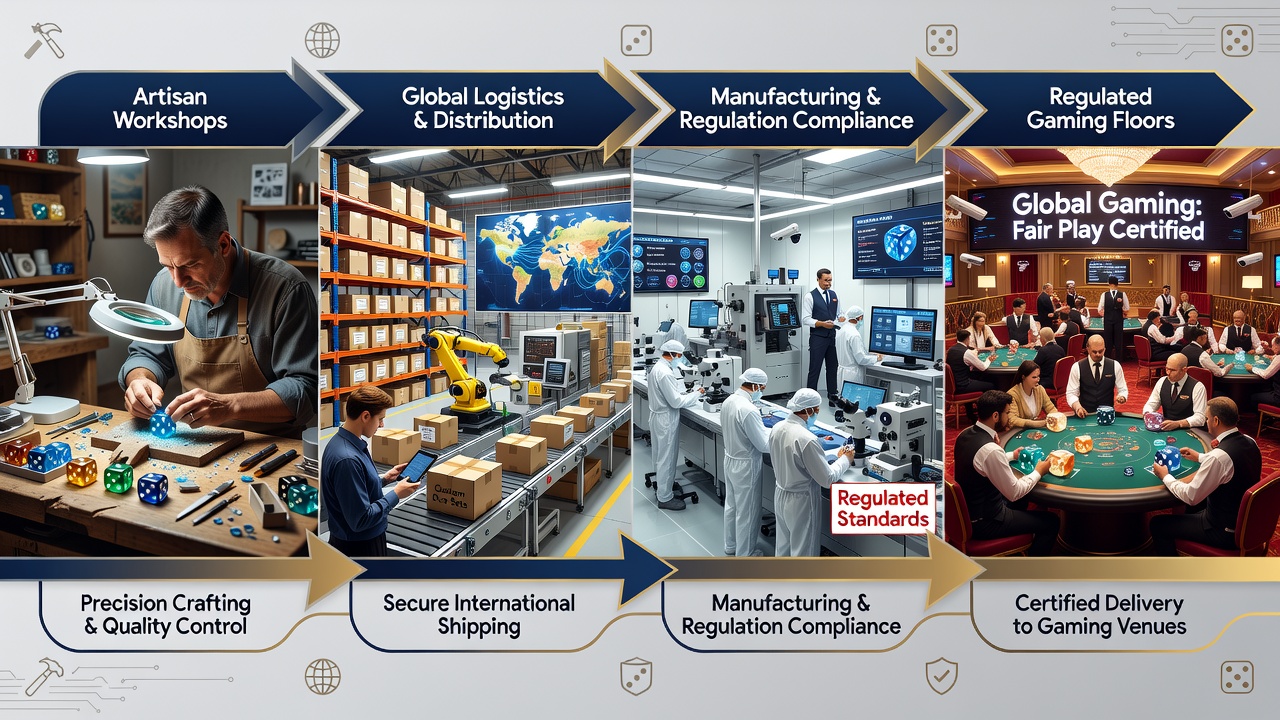
Custom dice begin their lives in small workshops where skilled makers select raw materials like cellulose acetate or precision-milled plastic resins, then shape each cube through a sequence of cutting, drilling, and polishing steps that establish exact weight distribution and edge sharpness. Observers note that these initial stages rely on hand-guided tools combined with early-stage measurement devices to maintain tolerances within fractions of a millimeter, while workers inspect each piece for internal voids or density variations that could affect later performance.
Material Selection and Initial Forming
Workshops source polymers and additives from suppliers across North America and Europe, choosing formulations that resist wear under repeated impacts and maintain consistent opacity for spot visibility. Research indicates that certain blends incorporate UV stabilizers and impact modifiers, allowing the finished dice to withstand the mechanical stress of high-volume table games without developing micro-fractures. Makers then embed the pips using contrasting materials or laser etching, ensuring the numbering pattern remains legible after thousands of rolls.
Precision Calibration and Fairness Checks
Once basic shapes are complete, technicians apply balance testing equipment that spins or floats each die in controlled fluids to detect any bias. Data from manufacturing records shows that rejected pieces often return for re-milling or enter secondary markets for non-gaming uses. Those that pass move to surface finishing stations where edges receive slight rounding or beveling calibrated to meet venue-specific requirements. Experts have observed that this calibration phase directly influences how dice interact with felt surfaces and tumbling patterns inside dice cups or shakers.
Regulatory Submission and Certification Pathways
Producers submit sample batches and detailed process documentation to oversight bodies such as the Nevada Gaming Control Board and the Alcohol and Gaming Commission of Ontario before any shipment reaches licensed venues. These agencies evaluate physical samples through independent laboratories that verify dimensions, weight symmetry, and randomness via statistical sampling protocols. Compliance documentation must accompany each production run, creating traceable records that link individual dice back to their originating batch and material lot numbers.
What's interesting is how international standards converge around core metrics even though each jurisdiction maintains its own testing regimen. Manufacturers therefore maintain parallel certification files that satisfy both North American and Asian regulatory frameworks simultaneously, reducing duplication while preserving audit trails.
Packaging, Logistics, and Global Distribution
After certification, dice receive individual serial markings and tamper-evident seals before placement into climate-controlled shipping containers. Logistics partners route these consignments through established trade corridors that connect European production sites with Asian casino operators and North American gaming floors. Figures from industry reports reveal that transit monitoring includes temperature and humidity logging because certain polymer compounds can shift dimensionally when exposed to extreme conditions during ocean or air freight.
Integration at Regulated Gaming Venues
Upon arrival at destination casinos, staff perform secondary inspections that compare received items against the original certification paperwork. Inventory systems log each die into secure storage until floor supervisors authorize placement on active tables. In October 2026 several large properties in Macau and Singapore completed upgrades to their dice tracking databases, integrating RFID tags into select high-limit dice sets to streamline reconciliation after each shift. Such systems allow rapid identification of any die that deviates from expected performance patterns during live play.
Training programs at these venues teach dealers and pit bosses how to handle and rotate dice sets according to manufacturer guidelines, minimizing premature wear while preserving the integrity of the fairness certifications already obtained.
Conclusion
The path from artisan bench to regulated gaming floor therefore encompasses material science, metrology, multi-jurisdictional approvals, and secure logistics. Each stage builds documented checkpoints that allow regulators and operators to trace any individual die back to its production origin, maintaining consistent standards across continents.